Mastering the Paper Outline Icon: Avoiding Common Pitfalls in Digital Design Assets
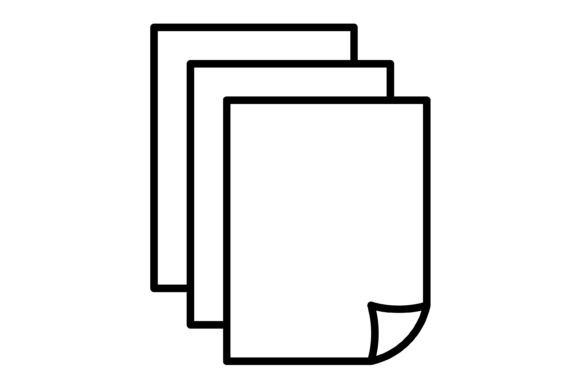
In the fast-paced world of digital design, the smallest details often carry the most weight. Among these, the Paper Outline Icon stands as a fundamental, yet frequently misunderstood, element. It’s more than just a simple graphic of a sheet of paper; it’s a universal symbol for documents, content, notes, and data. Whether you’re building a mobile app, designing a website, creating a presentation, or crafting marketing materials, the quality and implementation of this single icon can significantly impact your project’s professionalism and user experience. Many creators, from seasoned professionals to enthusiastic beginners, stumble upon the same avoidable errors when sourcing and using such assets. This guide aims to steer you through those common mistakes, ensuring your final product is polished, efficient, and effective.
The Critical Importance of File Format Selection
One of the first and most consequential decisions you’ll make involves the file format. A common oversight is grabbing the first available file without considering its application. The provided package includes AI, EPS, JPG, PNG, and SVG formats, and each serves a distinct purpose. Using a JPG for a website button that requires a transparent background will result in an unsightly white box surrounding your icon, breaking the design flow. Conversely, attempting to use a simple PNG for a large-scale print banner might lead to pixelation and loss of clarity, making your work look amateurish.
The better approach is to match the format to your medium. For websites and mobile apps, the SVG (Scalable Vector Graphics) format is often the superior choice. It scales infinitely without quality loss, keeps file sizes small, and can be easily manipulated with code. For projects where vector editing isn't possible but transparency is needed, like certain presentation software or image overlays, the PNG with a transparent background is your go-to. For professional print work or complex edits in Adobe Illustrator, the AI or EPS vector files are indispensable, offering full control over every line and curve. Treating these formats as interchangeable is a recipe for frustration and subpar results.
Overlooking Scalability and Resolution
A frequent mistake, especially among those new to design, is underestimating the power of vector-based icons like the Paper Outline Icon in AI, EPS, or SVG formats. These are 100% vector icons, meaning they are defined by mathematical paths, not pixels. A major pitfall is resizing a raster image (like a JPG or even a PNG) to fit a new space. Enlarging a raster icon will make it blurry and jagged, instantly degrading the quality of your interface or document.
The solution is to leverage the vector formats. Because they are easy to edit and scale, you can resize the paper icon from a tiny favicon to a massive hero illustration without losing a single detail of its crisp, clean lines. This is particularly crucial for responsive design, where assets must look sharp on screens ranging from small smartphones to high-resolution desktop monitors. Before you start, always confirm the native resolution of your source file and use the vector format whenever possible to future-proof your design against any size requirement.
Ignoring Design Consistency and Context
Even with a high-quality, versatile icon pack, applying the Paper Outline Icon without regard for its context can create visual dissonance. A common error is mixing icon styles. For instance, pairing a detailed, multi-weight outline paper icon with a set of bold, solid-fill icons elsewhere in your project creates an inconsistent and unprofessional look. The provided icons are designed with maximum usability in mind, featuring a consistent stroke weight and aesthetic meant to work as a cohesive set.
A better strategy is to establish a visual language for your project early on. Decide on an icon style—outline, solid, or a hybrid—and stick with it. Use the paper icon where it logically represents a document, a note, or a data file. Forcing it into a role where another icon (like a clipboard or folder) would be more intuitive can confuse users. Remember, icons are a form of communication. Their primary job is to be immediately recognizable, not just decorative. The 100 vector icons in the pack give you a broad toolkit to maintain this consistency across your entire design system.
Underestimating the Value of Editability
Many users download an icon set, use it as-is, and move on. While this works for simple projects, it overlooks a significant advantage of a professional asset pack: editability. The included AI and EPS files are not just for viewing; they are fully editable source files. A missed opportunity is failing to customize the icon to better fit your brand’s color scheme or specific design needs.
Instead of accepting the default black or gray, open the vector file in a suitable editor. You can easily change the stroke color to match your brand palette, adjust the line thickness for better visibility on dark backgrounds, or even subtly alter the shape to create a unique variation. This level of customization elevates a generic design into a branded, cohesive experience. It’s a practical step that separates a good design from a great one, and it’s a step many overlook due to unfamiliarity with vector editing software.
Making a Confident, Informed Decision
Before integrating the Paper Outline Icon or any similar asset into your workflow, a quick evaluation is prudent. First, assess the variety. Does the set offer the specific metaphors you need? A pack with 100 icons is excellent, but its value depends on whether it includes variations like a note, a document, a report, or a folded corner that suit your project’s narrative.
Next, verify the formats. Ensure the package includes the specific file types your software and platforms require. The inclusion of SVG for web and mobile, PNG for transparency, and AI/EPS for editing covers the vast majority of professional use cases, making it a robust solution. Finally, consider the licensing and scalability. A license that allows for use in templates and presentations is essential for freelancers and agencies. The promise that the icons are ready to use for all devices and platforms is a strong claim, but you can verify it by testing a sample icon across your intended environments.
By approaching the Paper Outline Icon not as a mere download but as a strategic design component, you empower yourself to avoid common frustrations. You ensure clarity, maintain professionalism, and ultimately create more effective and satisfying digital experiences for your audience. The right icon, used correctly, is a small detail that makes a big difference.