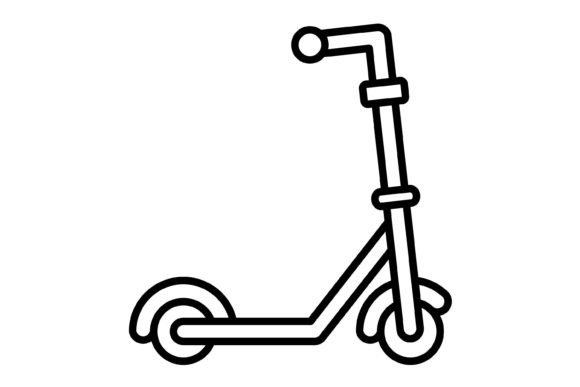
Kick Scooter Outline Icon: A Practical Asset for Digital and Print Projects
In the landscape of digital design, the clarity and versatility of an icon can significantly impact user experience and project cohesion. The Kick Scooter Outline Icon, available as part of a comprehensive asset package, presents a focused solution for professionals needing a specific, recognizable symbol. This article examines its characteristics, practical applications, and the value it offers to designers, developers, and content creators.
Understanding the Asset and Its Core Components
The Kick Scooter Outline Icon is more than a single image file. It is a carefully packaged resource delivered in a zip file containing five distinct file formats: AI, EPS, JPG, PNG with a transparent background, and SVG. This multi-format approach is fundamental to its utility. Each format serves a different stage of the design and implementation process, ensuring the asset remains functional from initial concept to final deployment. The inclusion of vector formats (AI, EPS, SVG) is particularly noteworthy, as it guarantees the icon can be scaled to any size without loss of quality—a critical feature for responsive design across devices.
The design philosophy behind this icon set emphasizes usability and consistency. As part of a larger collection of 100 vector icons, the Kick Scooter Outline Icon adheres to a uniform style, line weight, and grid system. This consistency is invaluable for maintaining a professional visual language across a project, whether it's a mobile application, a website, or printed materials. The "outline" style itself is a deliberate choice, offering a clean, modern aesthetic that integrates well with various backgrounds and color schemes without overwhelming accompanying content.
Practical Applications and Strengths
The true value of an asset like this is measured by its performance in real-world scenarios. For mobile app developers, the SVG and PNG versions are immediately useful. The SVG format allows for crisp rendering on any screen density, while the PNG with its transparent background can be seamlessly integrated into user interface elements, onboarding screens, or feature lists related to urban mobility, fitness, or delivery services. The scalability ensures the icon looks sharp on both a standard smartphone and a high-resolution tablet.
Web designers and front-end developers will find the asset equally accommodating. The SVG file can be directly embedded into HTML or used as an external resource, allowing for easy color customization via CSS and ensuring fast load times due to its typically small file size. For websites or blogs discussing topics like sustainable transportation, city guides, product reviews, or children's activities, the Kick Scooter Outline Icon provides a clear visual cue that enhances readability and user engagement. Its outline nature means it can be placed on both light and dark backgrounds with appropriate color adjustments.
Beyond digital applications, the vector formats (AI and EPS) unlock potential for print and presentation work. Marketing professionals creating flyers, posters, or presentation decks for clients in the mobility or lifestyle sectors can incorporate the icon at any size—whether as a small detail or a large decorative element—without fearing pixelation. Educators and bloggers can use it to illustrate articles or learning materials, adding visual interest without needing advanced design skills. The asset is ready to use, eliminating the time-consuming process of creating a custom icon from scratch for a specific, niche need.
Evaluating Quality, Usability, and Long-Term Value
A professional assessment of this resource must consider its design quality and flexibility. A well-designed outline icon should be legible at small sizes, balanced in its proportions, and visually harmonious when used alongside other icons or text. Based on the provided specifications, the Kick Scooter Outline Icon appears to meet these criteria through its inclusion in a set designed for "maximum usability." The consistency across the 100-icon collection suggests a systematic approach to design, which often correlates with a higher standard of output and easier integration into larger projects.
Usability is further enhanced by the file formats provided. The AI and EPS files offer full editability for Adobe Illustrator users, allowing designers to modify stroke weights, colors, or even individual path points to better suit a specific brand guideline. The JPG format, while less flexible than the vectors, provides a quick solution for contexts where a simple raster image is sufficient, such as in certain social media graphics or legacy system integrations. The PNG with transparent background is perhaps the most immediately useful for the majority of digital applications, offering a clean, ready-to-use element.
From a long-term perspective, investing in a well-structured icon library like this one can yield significant returns. The time saved searching for or creating consistent icons across multiple projects is substantial. Furthermore, the ability to maintain visual consistency strengthens brand identity and professional presentation. However, it is important to note that the asset's value is inherently tied to its relevance. For projects or industries entirely unrelated to transportation, mobility, or personal vehicles, its utility would be limited. It is a specialized tool, not a universal design element.
Ideal Audience and Situational Fit
The Kick Scooter Outline Icon is best suited for professionals and creators who regularly work on projects within specific thematic domains. This includes UX/UI designers developing apps for ride-sharing, fitness tracking, or delivery logistics. Marketers and content creators in the urban planning, sustainable transport, or children's product sectors will find it a practical addition to their asset library. Freelancers and small business owners who manage their own branding and marketing materials can use it to add a touch of professionalism to their communications without requiring a dedicated design team.
Situations where this asset proves most effective include: designing a set of icons for a new mobile application's feature list, creating an infographic about commuting options, developing educational materials about road safety, or building a presentation for a city council meeting on micro-mobility infrastructure. In each case, the icon serves as a visual shorthand, improving communication efficiency and aesthetic appeal.
Final Considerations and Recommendations
When evaluating the Kick Scooter Outline Icon, the decision hinges on project relevance and workflow needs. Its strengths lie in its multi-format delivery, scalability, consistency within a larger set, and clean, adaptable design. It performs reliably across digital and print mediums, offering genuine practical value to the right user in the right context.
A potential limitation is its specificity. It is not a general-purpose icon, and its usefulness is confined to contexts where a scooter symbol is meaningful. Professionals should also ensure the stylistic alignment of the entire icon set with their project's design language before full integration.
For those whose work intersects with mobility, transportation, or related lifestyle themes, this asset represents a worthwhile resource. It streamlines the design process, supports brand consistency, and delivers the technical flexibility required in today's multi-platform environment. As with any creative asset, its true worth is realized through thoughtful application aligned with clear project goals and audience expectations.