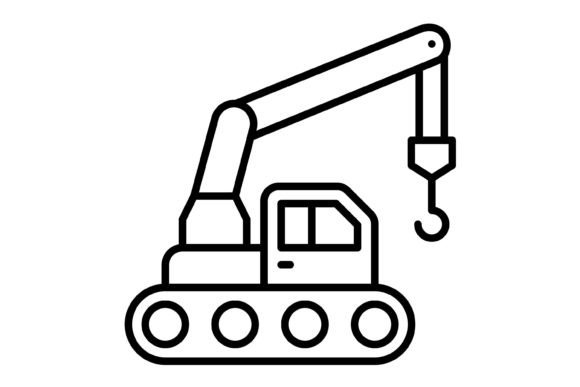
Understanding the Crane Outline Icon: A Practical Guide for Modern Design Projects
In the realm of digital and print design, the selection of specific visual assets often dictates the efficiency and clarity of a project. Among the various categories of vector graphics, construction and industrial imagery remains in constant demand. The Crane Outline Icon represents a specialized asset designed to bridge the gap between aesthetic minimalism and functional representation. Unlike complex illustrations or photorealistic renderings, this icon style relies on clean lines and negative space to convey meaning, making it a versatile tool for user interface designers, content creators, and print specialists alike.
The distinctiveness of the Crane Outline Icon lies in its adherence to modern design principles, specifically the move toward flat and outline-based aesthetics. In an era where screen real estate is valuable, particularly on mobile devices, heavy or overly detailed graphics can clutter a user experience. This icon solves that by providing a recognizable silhouette of a crane—whether construction, industrial, or mechanical—without the visual weight of solid fill or intricate shading. This approach ensures that the icon communicates its message instantly, a crucial requirement for effective iconography.
Comprehensive File Formats: Navigating the Zip File
A significant aspect of evaluating any digital asset is the flexibility of its delivery format. The Crane Outline Icon package is distributed as a zip file containing five distinct formats: AI, EPS, JPG, PNG, and SVG. Understanding the practical application of each format is essential for determining if this asset fits your workflow.
- SVG (Scalable Vector Graphics): This is often the preferred format for web developers and mobile app designers. Because SVGs are code-based, they are resolution-independent. They load quickly and can be manipulated via CSS, making the Crane Outline Icon ideal for responsive websites and mobile interfaces.
- AI and EPS: These are industry-standard vector formats used primarily in professional editing software like Adobe Illustrator. They are best suited for print production or situations where you need to edit the anchor points and paths of the icon manually. If you need to customize the stroke weight or color of the Crane Outline Icon for a specific branding guideline, these formats are necessary.
- PNG (Transparent Background): The inclusion of PNG files with a transparent background is critical for users who do not have access to vector editing software. This format allows the icon to be placed over any color or image background without a white box surrounding it, though it is rasterized and cannot be scaled up infinitely without losing quality.
- JPG: While less ideal for iconography due to the lack of transparency and lossy compression, JPGs are included for broad compatibility in presentations or documents where file size optimization is less critical than universal viewability.
Comparing Outline Icons with Other Styles
When researching visual assets, designers often compare outline icons against filled (solid), glyph, or 3D styles. Each style serves a different psychological and functional purpose.
The Crane Outline Icon occupies a specific niche compared to its solid counterparts. A solid icon creates a heavier focal point, which can be useful for primary call-to-action buttons but risks overwhelming a minimalist layout. Outline icons, conversely, offer a lighter touch. They are often described as more "airy" or "open," allowing the background to breathe. This makes the Crane Outline Icon particularly suitable for "white space" heavy designs, such as corporate dashboards, architectural portfolios, or clean mobile apps where the UI should not compete with the content.
However, this style does come with tradeoffs. In low-contrast environments or at very small sizes (such as 16x16 pixels), outline icons can sometimes lose legibility if the stroke width is too thin. When evaluating this icon, it is important to consider the specific environment in which it will be deployed. If the icon is intended for a dense data table with small row heights, a slightly bolder or filled icon might perform better than an outline style.
Technical Specifications and Scalability
The utility of the Crane Outline Icon is heavily supported by its technical construction. The package boasts 100 vector icons, suggesting a comprehensive set that likely covers variations of the crane theme—perhaps different angles, boom positions, or associated construction symbols.
The primary strength of vector-based assets is scalability. Whether you are designing a billboard or a 12-point font footnote, the mathematical paths that define the Crane Outline Icon remain sharp. This eliminates the pixelation issues associated with raster graphics. Furthermore, the description notes that the icons are designed for "maximum usability." In practical terms, this usually implies consistent stroke weights, alignment to pixel grids (to prevent blurry edges on screens), and balanced visual weight across the set.
For teams working across multiple platforms, the "ready to use" nature of these files reduces friction. A developer can take the SVG code for the mobile app, while the marketing team takes the AI file for the brochure, ensuring brand consistency without the need for constant file conversion.
Evaluating Fit: When to Choose This Icon
Determining whether the Crane Outline Icon is the right choice requires an assessment of your project's specific constraints and goals. This asset is generally the best fit for:
- UI/UX Design: Mobile apps and web interfaces that utilize a line-art aesthetic. The SVG format ensures the icon looks crisp on high-resolution Retina displays.
- Presentation Decks: Corporate presentations often require professional, understated imagery. The outline style maintains a sophisticated tone without distracting from the data.
- Print and Editorial: Magazines, brochures, or instruction manuals where icons are used to break up text and guide the reader.
Conversely, you may need to look for alternatives if your project requires high-visibility wayfinding signage in physical spaces, where solid, high-contrast icons are often more readable from a distance. Additionally, if your project requires an animated 3D model of a crane, a static 2D outline icon will not suffice, regardless of how well it is designed.
Customization and Editing Potential
A key selling point highlighted in the asset's features is that the icons are "easy to edit and scale." For a designer, this is a vital consideration. An icon that looks good out of the box is helpful, but an icon that can be customized is an investment.
Because the Crane Outline Icon is provided in vector formats (AI/EPS), a user can fundamentally alter the graphic. You can change the stroke color to match a specific brand palette, adjust the corner radius to make the lines sharper or softer, or even combine elements from different icons within the set of 100. This level of customization ensures that the asset does not look generic. Instead of using a stock icon that appears on thousands of other sites, you can modify the Crane Outline Icon to become a unique part of your visual identity.
Conclusion on Selection
In summary, the Crane Outline Icon set offers a robust solution for those seeking a balance between aesthetic appeal and functional versatility. By providing multiple formats—specifically the web-ready SVG and the editable AI/EPS—it caters to a wide range of professionals, from web developers to print designers. While outline styles require careful consideration regarding contrast and size, the benefits of scalability and a clean, modern look make this asset a strong contender for projects that prioritize clarity and minimalism. When comparing options, the inclusion of 100 variations and transparent PNGs suggests a comprehensive package designed to reduce the time spent searching for and modifying graphics.