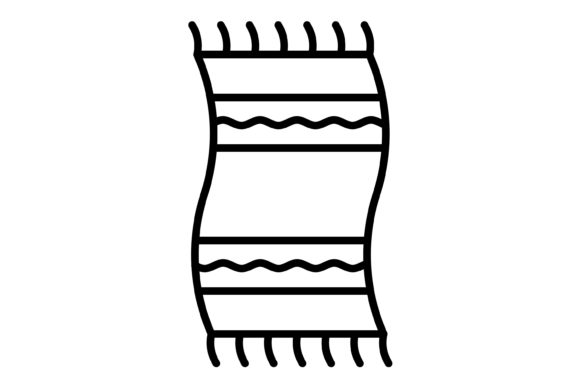
The Ultimate Beach Towel Outline Icon: 5 Essential Formats for Flawless Design
When you are building a brand, crafting a mobile app, or designing a presentation for a travel agency, visual consistency is your most valuable asset. It is easy to get distracted by complex illustrations, but sometimes the most effective design choice is a clean, minimalist asset like a Beach Towel Outline Icon. Whether you are a freelance graphic designer, a small business owner launching a summer sale, or a developer coding a weather application, this specific icon represents relaxation and leisure instantly. However, simply grabbing an image from a search engine is a rookie mistake that leads to pixelation, licensing issues, and wasted hours. To truly streamline your workflow, you need a professional, versatile toolkit that includes five distinct file formats: AI, EPS, JPG, PNG with a transparent background, and SVG.
Why File Format Diversity Matters for Your Project
A common oversight among beginners and even seasoned marketers is underestimating the technical requirements of their specific platforms. You might find a beautiful Beach Towel Outline Icon that looks perfect on your desktop screen, only to have it turn into a blurry mess when printed on a brochure or scaled down for a mobile app interface. This happens because different environments require different data structures.
For instance, a JPG file is excellent for web use due to its compression, but it lacks transparency, meaning you are stuck with a white box around your icon unless you use a PNG. Conversely, if you are handing off assets to a printing house for a large banner, they will likely ask for a vector file like AI or EPS to ensure the lines remain crisp at any size. By ensuring your icon pack includes AI, EPS, JPG, PNG Transparent Background, and SVG, you are future-proofing your project against technical limitations.
Avoiding the "Pixelation Trap" with Scalable Vectors
One of the most frustrating experiences in design is realizing too late that your icon cannot be scaled. Imagine you are creating a presentation for investors. You place a small Beach Towel Outline Icon on a slide, and it looks fine. But as you present, you zoom in to highlight a detail, and the icon becomes a jagged mess of squares. This is the pixelation trap, and it immediately cheapens the perceived value of your work.
The solution lies in using vector-based formats like SVG (Scalable Vector Graphics) and EPS. Unlike raster images (JPG/PNG) which are made of a fixed number of pixels, vectors are made of mathematical paths. This means you can scale a vector Beach Towel Outline Icon from the size of a postage stamp to the size of a billboard without losing a single ounce of quality. When you choose a pack that offers 100 vector icons, you are investing in assets that grow with your needs.
The Mobile App and Website Advantage
If you are a developer or a UI/UX designer, the SVG format is likely your best friend. It is lightweight, which means faster load times for your website—a critical factor for SEO and user retention. Furthermore, SVGs can be manipulated with CSS. You can change the color of the outline or the thickness of the stroke using code, allowing for dynamic interactions that a static JPG simply cannot offer.
However, a mistake often made in web design is using the wrong format for the wrong job. While PNGs with transparent backgrounds are great for complex graphics, a simple line icon like a beach towel is almost always better served as an SVG on the web. It renders sharply on Retina displays and high-resolution mobile screens, ensuring your interface looks professional on every device.
Practical Advice: Integrating Icons into Your Workflow
Let’s look at how to avoid inefficiency. A frequent complaint from creators is spending hours trying to edit an icon to match their brand colors because the source file wasn't included. This is where the inclusion of AI (Adobe Illustrator) files becomes a lifesaver.
If you are using the Adobe Creative Suite, having the native .ai file allows you to ungroup the vector shapes, change the stroke colors, and resize elements with total control. Without this, you might be stuck using a "Image Trace" tool, which often degrades the quality of the design.
Consider the scenario of a blogger writing about summer travel. They need a cohesive look across their Pinterest pins, their blog sidebar, and a printed PDF guide. By downloading a comprehensive pack of 100 vector icons, they ensure that every asset—from the suitcase to the Beach Towel Outline Icon—shares the same visual language. This consistency builds trust with the audience.
Checklist: What to Verify Before You Download
Before you commit to a design asset, you need to evaluate it beyond just the aesthetic appeal. Many users download icons only to find that they are difficult to edit or incompatible with their software. Here is a practical checklist to ensure you are making a smart decision:
- Editability: Are the lines expanded or are they live strokes? For a clean outline icon, live strokes are often preferred so you can adjust the weight of the line easily.
- Compatibility: Does the pack include formats compatible with your software? If you use Canva, you need SVGs or PNGs. If you use Illustrator, you need AI or EPS.
- Consistency: Does the Beach Towel Outline Icon match the style of the other icons in the set? Mixing line weights (e.g., a 2px stroke towel next to a 4px stroke sun) looks amateurish.
- Backgrounds: Always look for the PNG Transparent Background specification. A JPG with a white background is nearly useless for modern web design where colored sections are common.
Maximizing Usability Across Platforms
The true value of a well-designed icon set is its versatility. The prompt mentions suitability for Mobile Apps, Websites, Print, Presentation, Illustration, and Templates. This is not just marketing fluff; it is a technical requirement.
For Print, vector formats (AI/EPS) ensure your inkjet or laser printer produces sharp edges. For Presentations (PowerPoint or Keynote), a high-resolution PNG is often easiest to drag and drop, but an SVG can sometimes be imported for sharper results on 4K projectors. For Templates, having a library of 100 icons allows you to create social media templates that are reusable and visually appealing without starting from scratch every time.
The "Ready to Use" Philosophy
A major pain point for hobbyists and small business owners is the "technical debt" of design assets. Buying a cheap icon that requires 30 minutes of editing to remove the background or fix the clipping mask is not a bargain. A "Ready to use" icon set means the creator has already done the heavy lifting. They have ensured the Beach Towel Outline Icon is centered, the canvas size is consistent, and the file naming is logical.
When you use assets designed for maximum usability, you reduce friction. You spend less time fighting with software and more time communicating your message. Whether you are designing a logo for a pool cleaning service or creating stickers for a summer camp, the goal is the same: efficient, high-quality output.
Conclusion
In the digital landscape, visual clarity is paramount. A Beach Towel Outline Icon might seem like a small detail, but it contributes to the overall user experience and brand perception. By choosing a comprehensive pack that includes AI, EPS, JPG, PNG Transparent Background, and SVG, you equip yourself to handle any project requirement, from mobile development to large-format printing. Avoid the common mistake of settling for low-quality, non-scalable raster images. Instead, invest in 100% vector icons that are easy to edit and scale. This approach ensures your designs remain sharp, professional, and adaptable, saving you time and elevating the quality of your work across all devices and platforms.